
Thinking without words: lessons from a multilingual life
Updated: Mar 31
The child of parents from two different countries living in a third, I was born into a home where
languages intertwined and carried with them a sense of warmth and familiarity. That early
experience of language as something that brought people together shifted abruptly when I was
seven and we moved to the United States. I didn’t speak a word of English beyond fumbling
through “head, shoulders, knees, and toes”, and overnight, language transformed from a source
of connection into a barrier. Unable to communicate with the other children at school, I felt
alienated and frustrated by my incapacity to interact.
My relationship with language became more complicated when, three years later, my father
suffered a stroke that left him with aphasia, severely impairing his ability to speak and
understand words. What had once been a social obstacle now became far more isolating, as
our family searched for new ways to communicate together.
How do you communicate when you are voiceless? Can you share ideas if you don’t have the
words for them? Can you even think them? Does language shape the way we think, or is it the
other way around? Do our thoughts exist independently of language? Is language a key to our
inner worlds, or a cage that limits them?
I became obsessed with questions like these, and began learning languages compulsively,
collecting them like Pokémon cards. French, English, Spanish, Italian, Hebrew, Greek, German,
bits of Korean, phrases in Farsi, words in Danish – if I mastered enough languages, I’d never
again be unable to express myself fully.
Yet to my dismay, I realized that fluency was not enough. When I returned to Paris at 25,
speaking what I had thought was near-perfect French, I again felt like an outsider. I didn’t
understand slang, cultural references, idioms, formal registers, or niche vocabulary. Worse still,
my nearly accentless French led people to give me bewildered looks when I made basic gender
mistakes, didn’t know the lyrics to favorite throwback karaoke songs, or stared blankly as they
recited entire scenes from cult French films.
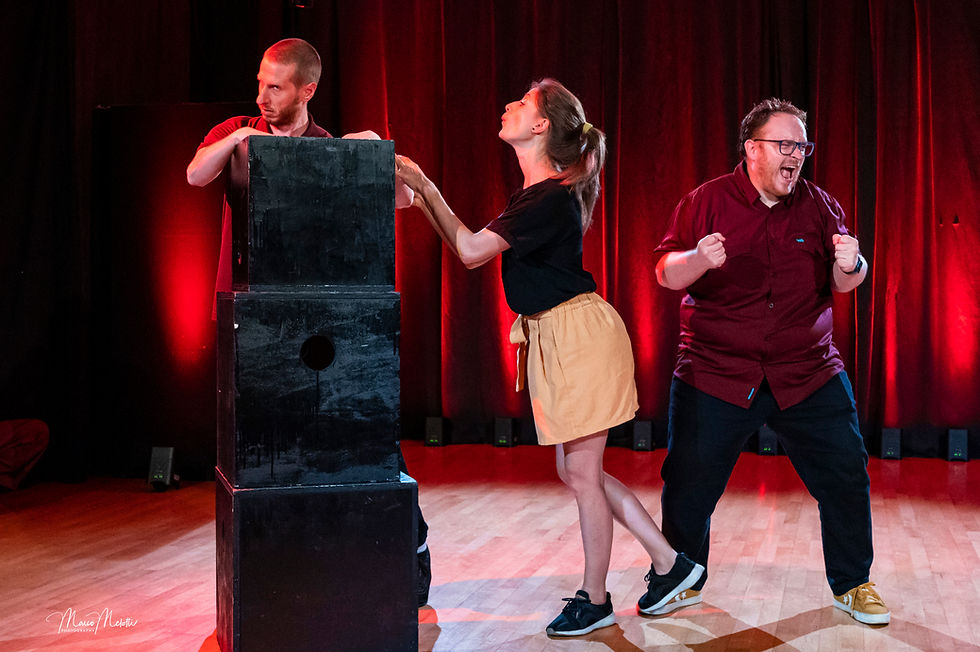
Looking for a way to connect with people, I turned to improvisational theater, which I had first
discovered in California. I signed up for a class, despite being terrified of making conjugation
mistakes, missing references, or having to manipulate invisible objects whose names I didn’t
recognize. I of course found myself in all of these situations, a horror to my perfectionist self.
And yet I kept coming back, as improv taught me, over time, to embrace the mistakes, the
confusion, the misunderstandings.
Some years have passed since then, and my relationship to language has only grown messier. I
now sometimes find myself struggling to find the right words in both French and English, no
longer certain which I can truly call my native tongue. Yet I am no longer ashamed of these
“shortcomings”, as I have learned to appreciate each language for what it offers, rather than
what it lacks.
So when the Bridges project began a year ago, it immediately resonated with me. It explores the
same questions that have followed me throughout my life: how people who don’t share words or
culture can still create together, and how improvisational theater can transform separation into
connection, and barriers back into bridges.
-Dalia Cohen


Comments