
Diary of a Bridge: part 5. SHOWS in Paris.

Updated: Mar 31
23/01/2026
Our days in Paris flow on and through water. We are housed in Rue de Nantes, in the 19eme arrondissement, a “dynamic neighborhood that houses numerous artistic scenes, large green spaces, and unusual spaces.” The most beautiful part of it is the Canal de l’Ourcq, a canal built by Napoleon in 1804 to bring drinking water to this part of Paris and enable navigation for shipping vessels that would avoid the Seine. It was opened for navigation in 1822, and it still contains 10 locks that were used to move boats along the canal.
Like the Bridges cast, the water arrives here from far away: from Ronchères, Aisne, where the river Ourcq is born, about 100 km from our rented apartment. It flows through Port aux perches, where this channel splits off from the Ourcq and makes its winding way through Paris. The name of the place tells us both that it was a port and also that presumably some of its inhabitants included and still include perch, a freshwater fish (Perca fluviatilis).
The flowing water offers a scenic and lively break from the city. The water is teeming with mallards, cormorants and black-headed gulls, among the usual crows and pigeons that inhabit most cities. They seem to be benefiting from a plentiful supply of fish living in the canal. The water is sometimes flat and silvery, sometimes green and choppy, depending on the day; a constant companion in our walks from Rue de Nantes to Passage Dubail, where our hosts’ office is. On one day I walk alongside a mallard duck who is swimming so fast against the current that he almost outswims me. Sometimes a light drizzle will dew our shoulders and faces as we are walking, weaving in between bike commuters, cars and runners.
Parked on either side of the canals are peniches, or riverboats of every size: the larger ones have been turned into restaurants and clubs. I start to notice the bridges because of the name of our project: they come in different sizes and shapes, including arch-shaped ones and drawbridges to permit the passage of boats underneath. Under some of the bigger canal bridges are small colonies of cheap 2-person camping tents, signaling the presence of the homeless. They also give shelter to the hundreds of birds, squirrels and other wild animals that live alongside humans in this part of Paris.

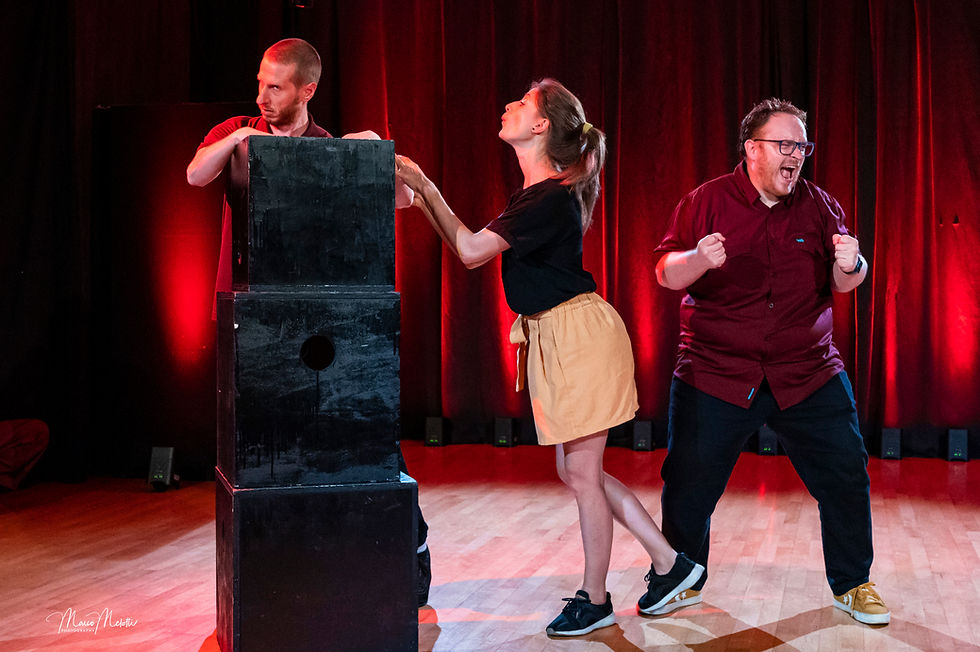
The theatre we play at is called, appropriately, the Théâtre du Gouvernail, which is the helm of a ship. We flow into Paris from different cities and countries, and gradually re-find each other and the work we are here to do. We all stand at the helm of our figurative ship and plot or replot our current course. We dig out the show synopsis, remind each other of it, remember the decisions we made about the structure and why. Our four performances are a gradual progression of energy, chemistry, spontaneity and fun. We agree that the format’s structure is not easy to play, but it definitely works in front of an audience. Our audiences are composed certainly of improvisers, but also comprise people of wildly different ages and even a few Hungarian, Slovenian and Italian speakers. The feedback is overwhelmingly positive. One text message from an audience member reads: “I felt you touched the substantial marrow of what improv actually is. A pure present.”
I recently read this quote from Improvisation for the Theater by Viola Spolin:
“The audience is the most revered member of the theater. Without an audience, there is no theater. Everything done is ultimately for the enjoyment of the audience. They are our guests, fellow players, and the last spoke in the wheel which can then begin to roll. They make the performance meaningful.”
And I think nowhere is this more true than in improv, particularly in our Bridges format.

At Belushi’s and Bar Ourcq, both on the canal, we make ourselves right at home with a crowd of tourists, students and young Parisians out on the town. At Paname Brewing Company, we are recognized by some audience members who giddily buy us shots (“madeleines”) and shower us with more compliments on the show.
When the work is done, as I walk along the canal de St. Martin to Gare de Lyon for my train, I think, How lucky to have studied French and be able to find my way alone in the city! Having visited places like Hungary and Slovenia where I wasn’t able to understand the local language have made me appreciate this so much more. The disadvantage of not speaking a language well or well enough is something that touches almost all humans at some point in their life. There are many parts of the show that deal with language barriers, frustration, status differences and struggling to connect. Perhaps there is a sort of catharsis that occurs, because the audience emerges looking enthusiastic and full. Some posit different theories as to why we structured it like we did. Interacting with them after the show is an enormous pleasure.
From my train car, it is beautiful to watch the countryside transform from city, to flat plains, to lakes and villages, to the imposing Alps. We cross over back in Italy in no time and suddenly everything is more familiar. I see the stars again, and search them, like sailors do, to find my way back home.


Comments