
The Joy of Copying

The battle of thoughts around originality in the arts really intrigues me. On the one hand a unique idea is something everyone is looking for. Something new, something fresh - a new style, a new genre, a new way of entertaining the audience. But we also think all good art has already been done and everything that is produced now is just a copy of past inspirations. Hence all the legal battles about the authorship of songs - you’ve probably heard of Ed Sheeran playing his guitar in court and proving that most pop songs use the same 4-chord progression. Master copiers sometimes become even more renowned than the originals. How is this connected to improvisation, where things are made on the spot? Of course our past experiences influence the material on stage. We want to be original, we want to come up with a unique idea (even though we’re taught to go with the obvious one) … and a lot of times that hinders our performance. People stay on the sidelines, because they can’t think of an original story. They watch their partners mime knitting something huge and can’t think of a way to join them. “I could just sit next to them and just mirror what they’re doing. But that would be lazy.” Or would it be a great supporting move?
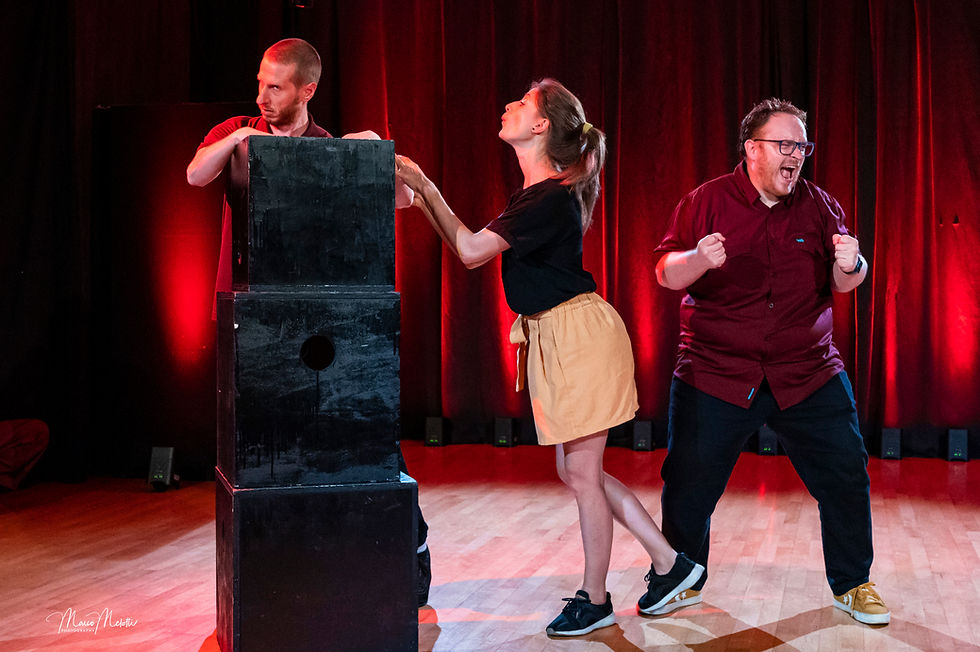
During the Bridges project the cast did a lot of exercises where we mirrored each other, be it mirroring faces, emotions, movements. Because we tend to use much less words than in an average improvised play, the flow of information is not as exact. For example: an onstage partner mimes giving me a gift. They can define in detail what it is with words. Or if they don’t want to, they can just pass an invisible box to me and I can say what it is. But if neither of us can say anything (or can only use gibberish or emotional sounds), the definition of the gift can be left to many interpretations. Which is great! We don’t have to define everything right away. Sometimes we don’t have to define things at all - and we’re going to have many stories about what the gift traveling around was. One will be my story, the other one my partner’s and then a 100 more (well depending on your audience numbers) stories of the show’s observers.

The one thing that sometimes gets lost and worries improvisers in non-verbal scenes is the connection between the actors. Because things are not as precisely defined, the connection sometimes feels off. A great way to connect is to become a Xerox machine and copy whatever your partner is doing or emoting. Your partner might in turn copy you and suddenly through this mirroring a connection is established.I use copying and mirroring exercises with my students frequently for exactly that reason and the work that we’ve done with the Bridges project has been a huge inspiration. One of the very valuable take aways is that copying doesn’t have to mean exact copying all the time. For example in the Lab in Italy we played with the “Mirror, Echo, Exaggeration Pairs” exercise, which had these steps:
Mirroring – Copying your partner exactly.
Echoing – Repeating your partner’s actions with a slight delay.
Exaggerating – Over- or under-emphasizing the movement your partner is doing.
This way you can take copying to another level. For example if your partner starts a scene fishing in a pond, you can join them by copying what they’re doing. Now, if you copy exactly their moves, the scene might look unusual - it’s not a dance performance, where everyone needs to be in sync. So, instead of precisely mirroring their actions, you can just do the action in your own style. Are you really good at fishing? Are you really bad? Are you bored about it or super excited? At first glance it might look a bit boring - just two people doing the same action. But if you have an attitude towards the action or you do the action in a certain style, things become way more interesting. And you have already established a connection - you’re doing the same action, therefore these two characters already have some bricks to build their relationship with.
We also used mirroring as a warm-up activity, again with the idea of connecting and seeking inspiration. One example is the Face Mirroring exercise. You pair up, make the same face together (by copying each other), then create a different face with another partner and a third one with your third partner. Then when you walk around the room and when you meet your old partner(s) you instantly try to recreate your original face. You can do the same with walking, moving, miming, vocalizing … It's a great way to co-create and can be a good way to push yourself into new characters and situations. Just think how many times you’ve heard that an actor based their character on a real life person. They copied their mannerisms and added their own touch. And we can be pushed to create characters that are out of our usual zone by copying in improvisation as well.
So, the next time you feel stuck - find inspiration in your partners and just CTRL+C their stuff. And don’t worry about not being unique - you definitely will be. We’re not perfect mirrors, so the copy will have your fingerprints all over it.
-Juš Milčinski


Comments