
The Evolution of the Bridges Format
One of the main goals of the Bridges project was to develop a theatrical format that would be
accessible to audiences who don’t necessarily speak English — or who have never seen
improvisational theatre before. From the very beginning, we didn’t know exactly what the
show would become. What we did know was that it had to feel alive, inclusive, and
understandable beyond words.
The process unfolded through three creative meetings that we called Labs: one in Hungary,
one in France, and the final one in Italy, where we tested the format and later premiered it in
front of a real audience. These Labs were not about defining the show too quickly. They
were about exploration.
In Hungary, we started from what we already knew — the tools and elements of
improvisational theatre that are part of our everyday practice. We shared exercises, taught
each other methods, and openly gathered thoughts and ideas. We explored language and
intimacy, different approaches to stage direction, physical theatre, and a wide range of
improvisational structures.
The concept of Open Spaces guided our process. It allowed us to stay curious and avoid the
pressure of turning the format into something concrete too soon. There was no rush. No fear
of not knowing. We tried to remain attentive to everyone’s input, opinions, and experience.
That felt rare. In traditional theatre structures, after the screenwriter, the director usually has
the final word. Here, we consciously stepped away from that hierarchy.
We also resisted the pressure of being immediately entertaining. Instead, we allowed
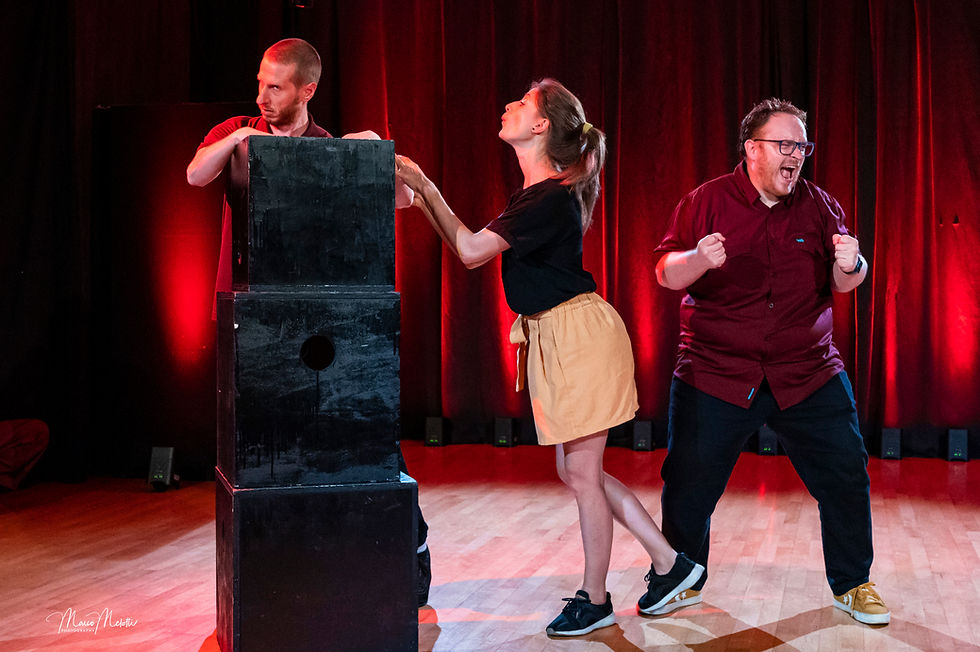
ourselves to dive into physical theatre, sound, space, silence, and all kinds of non-verbal
communication. Along the way, we often reached dead ends — and then simply stepped
back and tried another direction. Failure and error are natural and essential parts of
improvisation philosophy. I believe we truly embodied that openness and willingness to
experiment without external pressure.

Through this process, we gathered around 40 different games and scene structures that
could potentially be part of the final show. Through a democratic selection process, we
shaped a general structure — not a fixed script, but a clear line of development.
What impressed me most was how the philosophy of evolution became embedded in the
format itself. The show became a journey: from the uncomfortable space of not
understanding each other’s language, to gradually discovering connection through
movement, sound, gibberish, status, emotions, and shared stage direction.
The beauty of working in such an open way is that the process transferred directly into the
final product. Bridges became a flexible and lively piece of art that can be performed in any
country with performers from different linguistic backgrounds — as long as they share a
basic understanding of English and at least one native speaker is present in the cast.
Our initial wish was to create a show that works for audiences who do not speak English or
any foreign language. From the reactions and feedback of our first audiences, we felt we
were on the right path.
The evolution of the format is still ongoing. Each performance continues shaping it. One of
its most valuable aspects is that it can travel to theatre festivals with international casts of
experienced improvisers. It is an inclusive show that invites reflection about language and
cultural differences, while embracing awkwardness, miscommunication, and humor born
from mistakes.
But perhaps the most important thing is this: the show does not only expose communication
barriers — it offers a solution. It highlights the beauty of cultural differences and the
countless ways humans can connect, fight, fall in love, laugh, and play without speaking the
same language.
The evolution of the format is, in a way, the evolution of our understanding that language is
not only something we speak — it is something we embody.
-Vid Sodnik


Comments