
Diary of a Bridge: part 4. LAB and SHOWS in Italy.

29/06/2025
Bologna airport, Sunday, June 22nd 2025.
I pick up the Hungarian crew at Bologna airport.
The heat is oppressive. The parking lots and roundabouts are overfull with travellers arriving and departing. We depart as quickly as we can, carving our way North, through the Pianura Padana, a swath of flat land lying across the top of Italy, across the Po River, and through the foothills of the Venetian Alps.
These valleys were dug by glaciers millions of years ago, and today we ride in the opposite direction of those glaciers, of course at an infinitely higher speed.
In Fiave', Bronze age people built huts on stilts in the lake, lived their lives, loved each other, made pottery, domesticated animals. Much later, the Romans invaded, built forts and roads, appropriated the local pagan cults. Romans gave way to Venetians who gave way to Austrians. For several centuries Trentino was, with Slovenia, part of an Empire; it's funny to think of Jus, Vid and I growing up in the same country.
‘Country’ of course refers to nation but also the places outside cities, which is where we are headed.
We meet the rest of the crew at Castel Campo, some have come in from France by train (traveling Southeast), others by car from Slovenia (West). In the mountains, directions are more obvious. Most of these valleys flow North to South along with the mighty Adige river, which means that you always know where North is.

This is where I spent my summers as a child. These walls were so familiar to me even before my mother came to live here full time in 2002. We often speak of the castle as its own entity, in the sense of "it likes" or "doesn't like" (“he” in Italian, a language divided entirely into masculine and feminine.) In our family folklore we have decided that "it likes women", because throughout most of the 20th century and still today, the majority of its inhabitants have been women.
When you finally begin an experience that you have planned for so long, there is often a feeling of alienation, like it has begun but also not begun, like every moment is endless but also moves in a flash.
How do I translate a childhood home, a culture, a country to my fellow participants? What is important to say and not to say to my colleagues who are new to this place?
We work in the magnificent hayloft known as Maso Pacomio, with windows on all sides that show us the Dolomiti di Brenta and surrounding small hills. There is more tension than at the last labs, because we know we will have to premiere a show on Friday, and it doesn’t yet have a defined form. Even the most seasoned improvisers crave security at times. Also, we are aware that the audience will speak little to no English at all, which will be a new experience for most of us. We finally meet Max, our musician, who adds an entirely new dimension to the performance.
There are disagreements, of course, but we navigate them peacefully. Day by day, a structure emerges.
In between work sessions, we drink espresso after espresso, have long meals outdoors and spend the evenings by the fire in the brazier in the garden. Sometimes we play guitar and sing. The easy conviviality goes hand in hand with the crickets, the owls, the music floating over from nearby summer concerts.
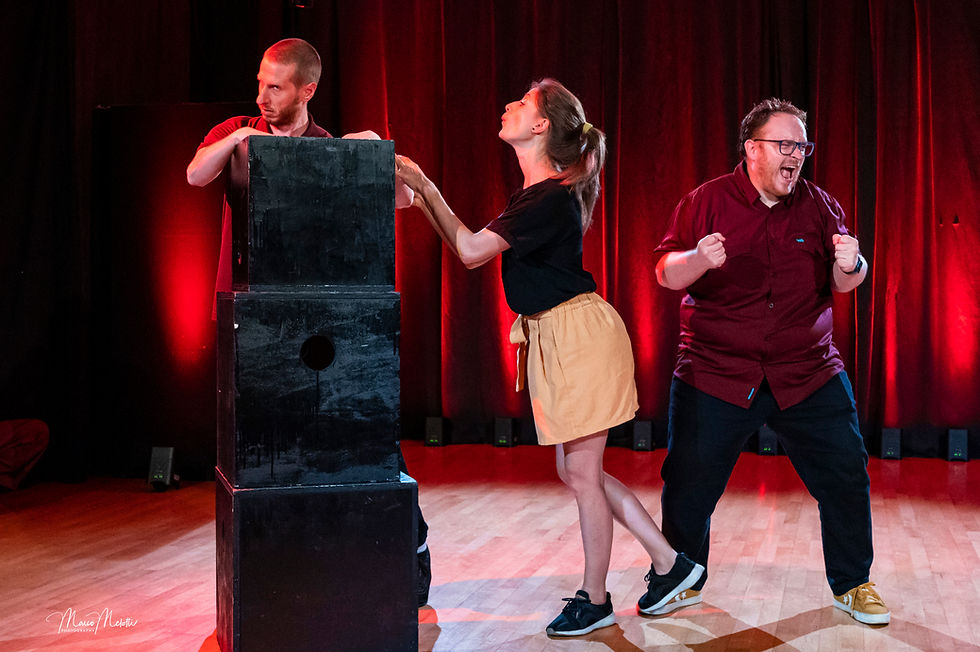
The first performance is in a beautiful local theatre, almost brand new, though only a handful of audience members show up. We pack up our things and move to a smaller blackbox theatre in Bologna, where the audience is packed in like sardines; there are many improv aficionados and a good amount of English speakers.
It all moves very fast. We stay up late at the hostel saying goodbye to each other, to the exploratory part of the Bridges process, and to Italy. It will be several months before we see each other or perform together again. Or is everything still happening all at once, and is it January 2026, and are we already in Paris?


Comments